



Addressing the long-term financial impact of weather-related fixture postponements on men’s professional football in England
A Pledgeball briefing prepared by Katie Cross (CEO, Pledgeball); Adam Davis (Lecturer of Sports Business, University Campus of Football Business, Manchester); Dr Mark Doidge (reader in Sociology of Sport, Loughborough University); Abi Hawkins (Scholar, University of Leicester).
——
Under the Football Governance Act 2025 (s10), the Independent Football Regulator (IFR) is obliged to prepare and publish a ‘State of the Game’ (SotG) report on the overall position of English football.
The IFR published a proposed ‘Terms of Reference’ (ToR) for this report in January 2026. During the consultation, it was observed that climate impacts were not included in these terms of reference, despite the well-recorded economic implications of climate change.
The IFR said they would “consider this further as part of our assessment of systemic resilience.” This comes under ToR 2.4; specifically “resilience to macroeconomic and other shocks.” The IFR also stated that they will “consider the international context”.
It is clear that climate change is already having an impact on the national game at all levels. As analysis produced by Alma Economics for the the Department for Culture, Media and Sport (DCMS) in 2025 explained:
Climate change is disrupting grassroots sports, with flooding, droughts, and heat waves becoming more frequent. Clubs face financial strain due to facility damage, event cancellations, and declining participation.
Without action, rising costs may make grassroots sport less accessible. The sector already incurs £320 million annually in weather-related costs, projected to increase by £95 million under 2°C warming and £190 million under 4°C warming.
The Met Office projects that climate change will lead to an increase in extreme weather events By 2070, they estimate winters in the UK could be “between 1 and 4.5°C warmer and up to 30% wetter.”
Purpose
This briefing highlights the relationship between more frequent extreme weather events, the resulting rise in fixture postponements, and lost matchday revenue, along with the associated minimum financial costs.
In light of the Met Office’s projections and the findings of the recent Climate Change Committee Report, we expect these costs to increase in the coming years and decades.
Methodology
First, we compiled a dataset of postponed fixtures and their immediate causes across the top six tiers of English football, covering the 2021/22 to 2025/26 seasons.
In parallel, we collated attendances for every fixture played by 63 clubs in the same leagues for the same period. Fixtures were then categorised as either weekend or midweek matches. Friday night games were classed as weekend fixtures, while Monday night ones were treated as midweek fixtures. Bank Holiday fixtures were omitted due to their unique character.
The average midweek attendance was then compared against the average weekend attendance for each club and season (AverageMid%Wknd). We then calculated an average for each season.
This approach offers a proxy measure for the potential economic consequences of one aspect of climate-driven fixture postponements. Given the density of the fixture lists that clubs face, postponed matches are often rescheduled from the weekend to midweek. If, as anticipated, midweek attendances are generally lower than weekend attendances, it follows that such postponements would have a negative impact on clubs’ balance sheets.
As things stand, clubs are not required to publish detailed financial information. More granular revenue data would allow for a fuller analysis of how much clubs lose when a fixture is moved to midweek.
Findings
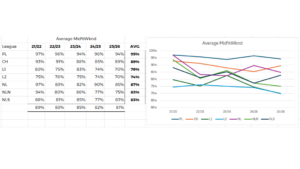
Figures 1 and 2: Table and graph showing the average attendance at midweek fixtures as a percentage of the average attendance of weekend fixtures in the top six tiers of men’s English football between 2021/22 and 2025/26.
The postponement data showed that waterlogging was one of the main causes of cancelled fixtures. Flooding, where a ground becomes inaccessible, also features, including cases at Rotherham United, Wigan Athletic, and AFC Wimbledon.
The Premier League recorded almost no weather-related postponements over the period, largely because most stadia at this level have modern drainage and heating infrastructure. Postponements were more frequent in the EFL, and highest in the National League, where such facilities are relatively rare.
There was a higher incidence of cancellations in the most recent seasons, with a marked cluster in 2025/26 related to several prominent storms; a potential indication of the trend forecast by the Met Office.
Since postponed fixtures are typically rescheduled to midweek, the resulting drop in attendances is noteworthy. Across all leagues and seasons measured in the second dataset, the average attendance for midweek fixtures was lower than those that took place on the weekend. The average midweek attendance was 84% of the weekend average. However, the difference between midweek and weekend attendances varied depending on the league in question. This phenomenon worsened over time.
Premier League teams saw minimal differences between midweek and weekend attendances, reflecting high general demand for live topflight football regardless of when it is played.
The divergence between midweek and weekend attendances widens progressively down the professional pyramid, reaching its largest gap in League Two. The average midweek attendance was 89% for the Championship, 76% for League One, and 74% for League Two. Given that lower-league clubs typically experience more weather-induced postponements, this raises significant financial concerns.
The disparity was smaller in non-league football than in League One and League Two. Even so, as mentioned, non-league games are the most frequently cancelled, and while EFL clubs benefit from substantial broadcast revenue, most non-league ones rely almost exclusively on match day revenue. Fixture postponements will therefore likely have a greater financial impact on the National League.
Financial implications
Fixture postponements hit clubs on several fronts.
The most direct is turnstile revenue, as fewer tickets are sold. Fewer supporters through the gate also means reduced spend on products in the club shop, catering, lotteries, hospitality, and so on.
Postponements themselves carry additional costs such as wasted food and matchday programmes, as well as staff costs incurred regardless of whether the game goes ahead. They also impose operational costs tied to extreme weather itself, such as pumps to remove floodwater or extra water provision during heat waves.
In the long run, clubs face the prospect of rising insurance costs and possibly reduced sponsorship fees if corporate partners no longer receive the audience exposure they have come to expect.
Supporters are also affected by rearranged fixtures. Beyond the obvious disruption to their schedule, they are more likely to have to travel to midweek games by private car rather than public transport, since buses, trains, and trams run less frequently on weekday evenings. Those who pre-booked train or coach tickets for the original weekend fixture may also be subject to additional costs if those tickets are non-refundable.
Conclusion
Weather-related fixture postponements are a growing challenge for men’s professional football clubs in England. They have real and measurable financial consequences, with the greatest impact falling on those least able to absorb them. Enough raw data now exists to begin quantifying this risk; the most pressing question remains how to minimise it.
Recommendations
We propose three measures to address the concerns raised in this briefing.
First, a full independent inquiry should be launched into the climate risks facing men’s professional football in England. This should assess both financial exposure and infrastructure resilience across the pyramid.
Second, environmental sustainability should be written into the IFR’s club licensing requirements, following the precedent set by UEFA and the Bundesliga.
Third, funding and financial support should be made available to clubs for climate adaptation and mitigation measures. In view of the operational costs identified, targeted funding would allow clubs, particularly those most reliant on matchday revenue, to proactively invest in resilience, instead of simply absorbing losses as they occur.
——
We would like to thank First Street, part of MSCI, Isaac Brookes, Ben Mole, Harry Law, and Meredith Whiting for their help in preparing this briefing.