



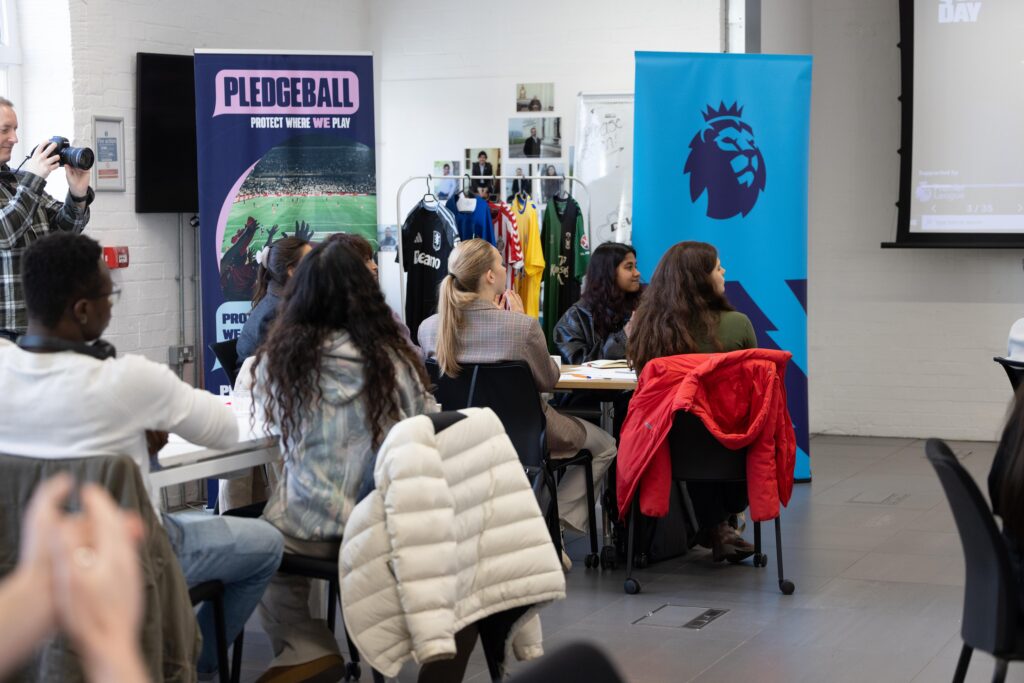
The Kit Hackathon, Sponsored by the Premier League
Sponsored by the Premier League, Pledgeball's Kit Hackathon explored more sustainable solutions to the issue presented by producing football kit.

How can kit culture be more sustainable without sacrificing profitability?
In a Hackathon sponsored by the Premier League, Pledgeball set a group of university students the challenge of coming up with a sustainable solution to football fashion.
Football shirts are more than just a piece of clothing for fans to wear, they’re a uniting identity for fans to support their club whilst also serving as a commercial lifeline for teams.
However, with new kits every season, unused and discarded shirts pile up year after year, causing environmental damage and fuelling fashion waste.
For clubs, simply selling less shirts is not a viable option due to the invaluable income they provide.
The question becomes; how can we make kit culture more sustainable without sacrificing profitability?
This is the exact dilemma participants in Pledgeball’s Hackathon were given.
On the 25 October, a group of students assembled at the University of Greenwich and were given the challenge to devise and present new sustainable alternatives to football kit production.

The main goal of the Hackathon was to ask how clubs can reduce kit and merchandise waste by changing the way they think about selling existing shirts.
Groups were tasked with coming up with a strategy for clubs to adopt a sustainable kit culture while maintaining their fan engagement.
This created an open discussion over what viable and sustainable alternatives to kit productions football clubs could adopt.
During the process, students were mentored by Joanna Czutkowna from 5Thread, an expert on sustainable sports apparel.

Katie Cross, Pledgeball CEOIt was fantastic to see so many young people bring such innovation and passion to the challenge. The hackathon really showed how much this new generation cares about protecting the things we love.
The ideas put forward needed to be commercially viable and work within the structures that already exist. We also have to cut down the plastics that pollute our waters every time we wash our kits, but ultimately these solutions still need to scream ‘football’ to people.
After forming and refining their ideas, the groups then pitched them to a panel of judges, including Joanna, Julie Brown the Head of Innovation at Crystal Palace and Pledgeball’s very own CEO, Katie Cross.
With solutions ranging from turning shirts into stadium seats, to embedding NFTs offering access to exclusive content to handmade goal nets from old shirts, the event posed an impressive range of practical solutions to explore.
The winning group of students were given the opportunity to further their ideas before presenting it to Crystal Palace’s commercial team.
It was a thought-provoking and inspiring event, and Pledgeball hopes to both expand on the event and explore the feasibility of some of the solutions with some very enthusiastic clubs.